
Watercolour Landscape
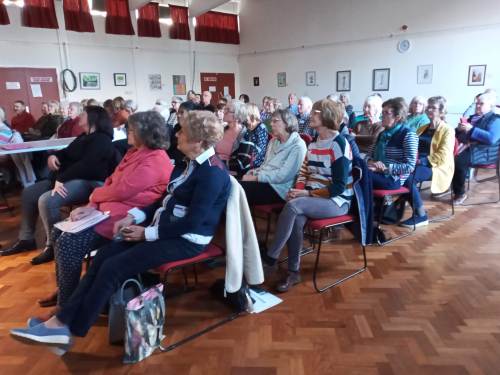
A large audience of members and visitors greeted self-taught artist Tim Wilmot on his second visit to Frome Valley Art Group for a demonstration in watercolours.
From a selection of photos of the locality, Tim picked one of the local duck pond, taken by a club member. Although living in the South Gloucestershire area, he’d never visited the pond, saying that this would be his first attempt at painting this scene and that no preliminary work or sketches had been prepared. The photo was chosen because of its sense of depth, possessing a good fore-, middle- and background, along with the reflections in the water. The photo carried a wide range of contrasts, which he liked.

Having decided on the focal point, working on Sanders Waterford cotton paper and a HB pencil, Tom drew in the baseline for the water, ensuring it was horizontal, before adding outlines of the distant houses, the islands and foreground, taking his time to make it was an accurate depiction of the scene set out in basic shapes. For the trees, Tim drew in the main trunks, indicating a few branches. He drew no reflections in the water in case the pencil lines showed through too much in the final painting, nor did he use masking fluid, saying he would be handling these differently.
For Stage 1, with a size 6 mophead brush, Tim began washes of 50/50 cerulean blue and cobolt for the sky, working from the top down. Painting loosely in all directions, avoiding horizontal strokes, towards the roofs, more water to the mix was added to lighten the colour, painting over the roofs but leaving what would be white areas unpainted, before adding a little red to the roofs themselves, with a small amount of yellow ochre to the left where the light hit. With a little red plus yellow ochre for the bush on the island, again loosely painted he then painted the grass areas with spring green plus a little red, mixing and remixing and avoiding the tree trunks.
As the water is darker than the sky, using ultramarine plus cobolt blue, this was painted again avoiding horizontal strokes, in vertical strokes for movement and shadow, lighted to the righthand side of the water to lighten, avoiding using white. A mix of lemon yellow/burnt sienna/yellow ochre was used for tree trunk reflections. The foreground edge of the pond was painted with cadmium orange and yellow ochre, spring green for the grass made more vibrant in the middle area.

In Stage Two, still using the mop brush, Tim painted the shadows of the buildings, and around the light areas of the roofs with a mix of alizarin crimson, ultra blue and burnt umber. The distant tree were added down to the top of the hedge, working across in dark cerulean. Switching to a flat brush with a mix of orange/red and gouache, larger tree branches were added. A darker green of veridan green/burnt umber/ultra blue was used for the hedge, and the same colour down to the water line. The retaining wall was painted in the same colour as the tree trunks, then the major limbs where they catch the light.
For reflections, Tim used the mop brush with a darker blue to help create movement as the reflections were not horizontal. Those in the middle foreground were lighter, and cooler/darker on the righthand side of the island. For the vertical reflections of the islands, shadows and trunks, a flat brush was used, using a finger to soften the edges. Darker shadows in the foreground were painted with ultra blue/alizarin crimson, and darker green “splats” for the foreground grass.
Moving back to the trees, with a mop brush and little darker paint, and in downward strokes from the top of the paper, he added the top canopy, creating the illusion of tiny thin bare branches. Next, using a rigger and a dark colour, the main limbs of the distant trees were added, leaving plenty of gaps. The timber on the builders were painted in and a few windows, nothing too detailed. With the same colour as the distant tree trunks, a bench was added to the grass bank. Switched to the flat brush, lighter green highlights were sparsely added to the island, and cobolt blue plus a neutral tint to add a few shadows to the bush and its base, always bearing in mind the direction of the light.
Using cadmium yellow with spring green on an almost dry rigger, strokes were made in a downward direction on the central willow tree. Finally, because the ducks would show up more on the darker areas of the water, a mix of naples yellow with yellow ochre gouache on a small synthetic brush, Tim painted blob shapes for the ducks, larger in the foreground, adding a dark ultra blue for the darker ducks.
The final painting was a delight, as was the whole demonstration.

It is here I must apologise for the lack of photos during the demo’s progression as with the overhead lights off, curtains pulled and only a light over the easel, the majority of photos taken were very dark, others a blur from the easel lamp, so I trust the above report, if a little long, gives a fair representation of the demo. Tim is a fabulous artist as his website testifies. He also has many online painting tutorials and demos available on YouTube which are well worth watching.

 FROME VALLEY ART GROUP
You must be logged in to post a comment.