
Watercolour Landscapes
The evening’s art demonstration began with a special “sangria and nibbles” social gathering, with drinks supplied by our Chair and members providing a delicious assortment of finger food, before sitting down to watch our guest artist Steve Hall.
Steve started his demo by explaining he would first paint a warm-up/practice piece of his chosen photograph – a winter scene – and the colours he would be using: cobalt blue (CB), ultramarine blue (UB), burnt sienna (BS) and burnt umber (BU), saying he mainly uses Rembrandt brand paints but happily mixes with other “artist” quality brands, ie W&N. He never uses black, preferring to mix his own, and paints with a limited palette.
On 140gm Bockingford paper and using a “Chinese brush”, he covered the paper in his loose and quick style with undercolour (CB and BU) just to get colour on the paper, emphasising it is difficult to judge when it’s dry enough to move on, the secret being practice, practice, practice, it doesn’t matter if the painting is not right, just keep practicing and eventually you will be “in the zone”.
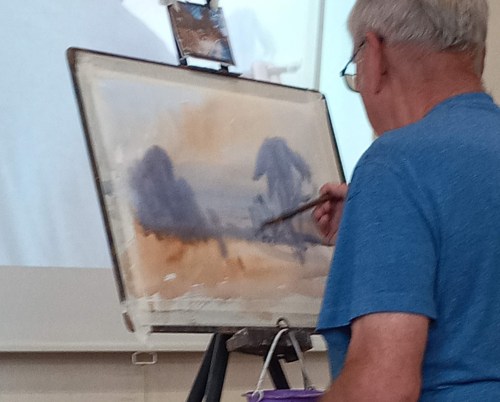
As the undercolour dries, working from the centre out, he painted the shapes of the distant trees. Switching to a reservoir brush, he added the foreground trees with BU straight from the tube

Waiting until it was the right time to scratch out the lighter marks, ie tree branches, if done too soon the wet paint will run back into the scratch marks. In less than 20 minutes this warm-up painting was complete.

Moving on to the real painting, he drew lines creating 3rds on the paper to achieve the focal point in the centre, drawing the shapes within the photo he is copying. Covering the whole paper in CB, he also left a lot of white space this was a snow scene.
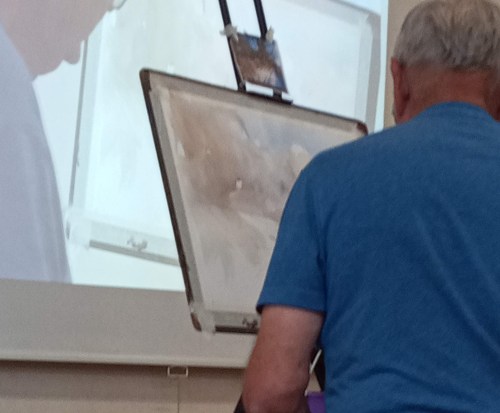
After painting in a few clouds with BU, he then added darker brown for the distant trees and bushes and, whilst paper was still damp, added in the nearer trees.
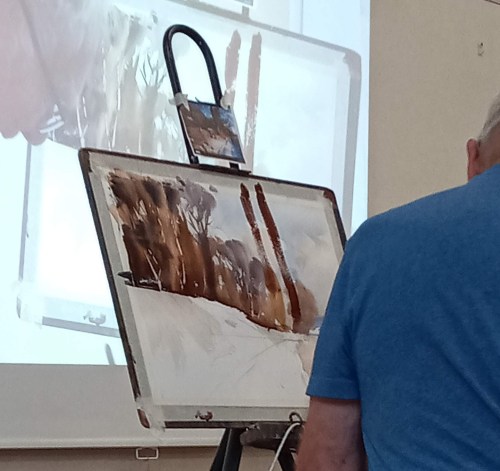
Explaining large areas are difficult to paint so he likes to put down a lot of colour in one go, with a lot of water on the paper, enabling him to paint straight over with dark colours. a fence, bushes and foreground were added, again very simple and loose. Branches and twigs were scratched out with a diamond shape palette knife. Shadows, were then added. Within another 20 minutes this second painting was complete. Steve placed it in a frame so we could see the overall result, which was amazing.

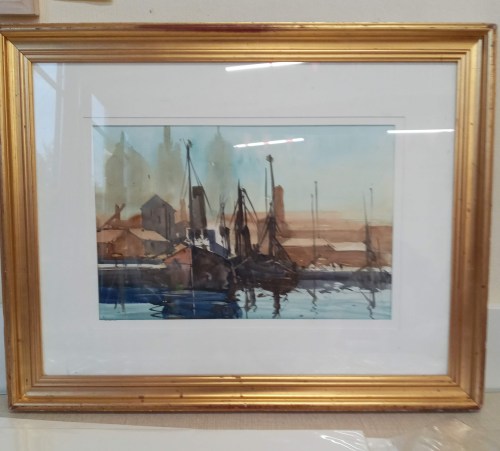
If two paintings were not enough, after a short break, Steve began a 3rd piece, this time of boats in Liverpool docks. Keeping the picture as simple as he could as the picture he was using was a complicated, busy scene, he draw the shapes of things he wanted to include. In his loose, swift style, the sky was put in (CB) a pale yellow/green brown for the land and distant buildings, and CB again for the water.
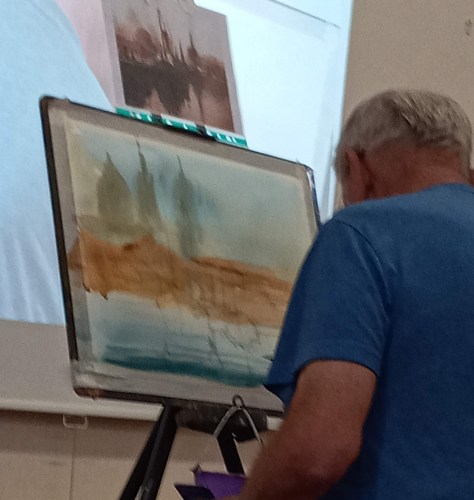
The water still being wet, he painted in the ripples using a darker blue mix then painted in the foreground boats and detail. Any errors made, he wiped off with damp paper to correct, ignoring any paper cockling that may occur. The nearer buildings were added using the reservoir brush, again with little detail, working purely on shapes.

Almost by magic, the scene unfolded before our eyes within approximately 30 minutes. Once complete and dry, Steve slipped the painting into a frame. Incredible work!
During the session Steve imparted some valuable and useful tips:
- Explaining he invariably starts with a warm-up piece to help relax, because artists are often too tight and tense when painting, so anxious are we to achieve a masterpiece at our first attempt of any painting. The more loose and relaxed we are, the better the result.
- If copying a photo, try to forget you are copying it and make the image your own, let the artwork take on its own life.
- If things go wrong or you put something in the wrong place or you are not happy with it, don’t panic, turn it into something else, or create a shadow, an extra tree or bush etc.
- Keeping standing back to look at your work as you go, that way you see more, notice more and can see what needs changing or adding.
- Shadows are crucial and useful to bring a painting to life.
- Most important of all: practice, practice, practice.
A thoroughly enjoyable demonstration and evening, showing what can be achieved in a short time using a limited palette in watercolour art.
A few of the comments from members following Steve’s demo:
“A very exciting demo.”
“I thoroughly enjoyed this demo. Thanks to all who made it possible.”
“A lovely way to spend an evening.”
“A great demo.”
“Really enjoyed last night and learnt a lot.”
“He made it look so easy!”
We hope we can welcome Steve back in the future.
Note: For those members unable to attend the demo or wish to see it again, there is a link to the demo video in the Members section.
 FROME VALLEY ART GROUP
You must be logged in to post a comment.