Y Garn Mountain in Oils
David’s began by explaining why he enjoys painting en plein air especially as when the light changes, the more he sees and that today’s demo would be from his own photograph taken whilst pursuing his other favourite passion, that of mountain walking/climbing, choosing an image of Y Garn in Snowdonia.
Instead of using acrylics as we expected, David had chosen oils, his preferred medium, using Michael Harding and Winsor & Newton brands. The colours used were:
White Titanium (WT), Burnt Sienna (BS), Alizarin Crimson (AC), Raw Umber (RU), Ultramarine Blue (UB), Cerulean Blue (CB), Yellow Ochre (YO) and Purple (P), plus Michael Harding brand Miracle Medium (developed to replace the potent odours of thinner and turps).
Mixing WT+YO, a loose sketch of the mountain shape was painted on a 16×20″ canvas using a 1” varnish brush, holding it by the top of handle to give more control. Next, base colours were blocked in with P, WT, UB and BS, adding the medium to these to thin down. This base layer replaced the need to prime the surface. To tone down the P, YO (its complementary colour) was mixed in. The edges of the canvas were also painted.

An earthy green was made using UB+YO with a tiny amount of WT. David took his time when mixing colours, constantly checking with those in the photo in order to get them right, where necessary adding BS to take down the green, before “scrubbing” these into the canvas. After this, he blocked in the sky with CB.
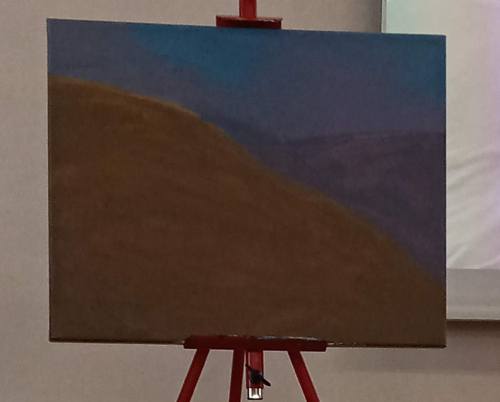
With a No.6 filbert (Rosemary Ivory Range), the darker parts of the sky were painted in with UB so that the lighter elements (CB and AC) could be scrubbed in over the top, using AC to darken. UB+BS for the dark space (the triangular area) at the top of the mountain was painted next and WT added to the mix to scrub in the clouds.
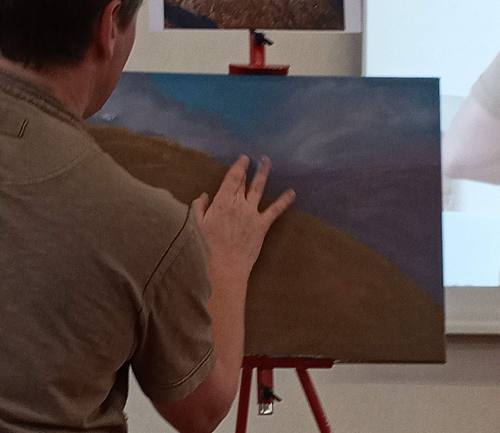
With WT+medium and AC+YO, he used his finger to add subtle marks in the clouds, and a bristle brush, allowing this to freely create the clouds, teasing out with a fan brush to blend in, taking care not to over-blend or over-work the paint. Here and there a touch of pink was added (WT+AC).
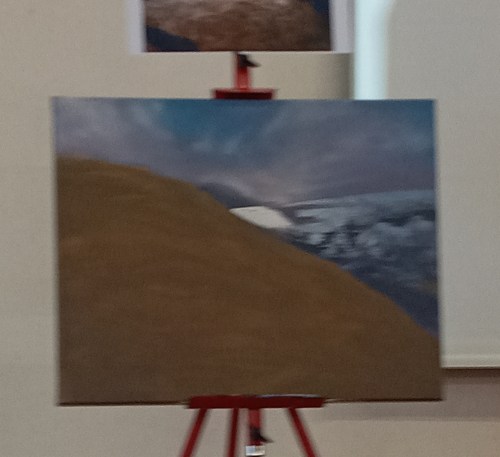
The dark area at the base of the mountain was painting using UB+RU+P (creating black) and “slapped” on with a palette knife. Mixing UM+CB+WT to make a blue-grey, a thin layer was scraped into the canvas with the knife to create the snow texture, adding more WT to the mix, each time scraping it on using both a pointed and a flat palette knife. For the lighter snow, WT+AC+a small amount of YO were added.

Working loosely, the darker textures of the main mountain were rubbed on with the knife, a method David terms “sculpting”, avoiding being over meticulous-in copying every detail. Lighter textures were added (WT+YO+BS+tiny bit of UB) with a chisel palette knife, making various rock shapes. Further textures were created by putting the knife flat to the surface and lifting it straight off, ie tapping the canvas. Pink+P+green were tapped, scraped and bounced along the mountain ridge.
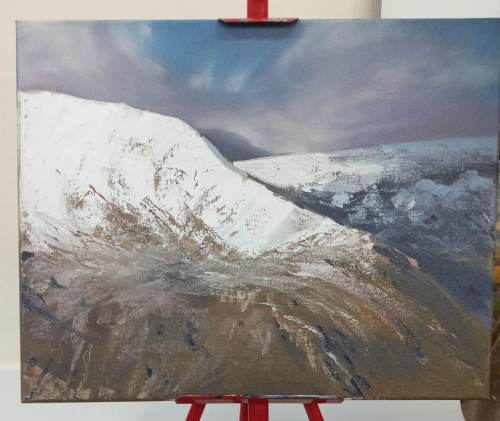
Using WT, the snow capped ridge in the centre of the picture was added. This stood out brightly amongst the darker elements with great effect.
WT was lightly scrapped into the lower snow around the bowl of the mountain. Finally, with a brush, the highlight on the the top of the mountain ridge was painted in before using the palette knife pulled down the slope, playing with it to squash the paint in dabs and bobs, creating more texture.
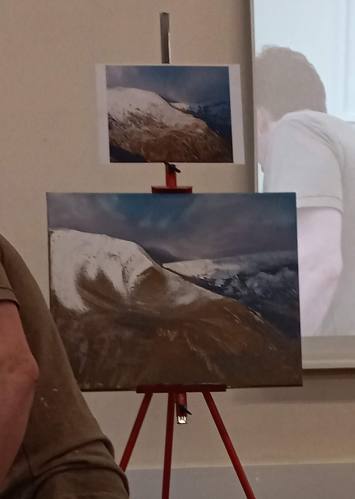
The final painting was an incredible likeness of the original photo much to the delight of a packed audience who appreciated every moment.
Several hints and tips were given, ie
• To tone down colour with its complementary one from the colour wheel
• A painting do not have to be an exact copy of the subject or be totally realistic, otherwise it loses its soul.
• To add sunshine add YO.
• The Liquid medium he uses speeds up the drying times of oils, usually to one day.
• Black backgrounds can be improved visually by going over with AC.
• A Burnt colour adds warmth, a Raw colour adds coolness.
• When asked how he cleans his brushes, he explained he wipes them on a rag then keeps them in vegetable oil. When needed he simply wipes again to re-use. Other than that he uses white spirit.
During this fascinating demonstration, David regaled us with amusing anecdotes, interesting observations and all delivered in his easy, cheerful style; a joy to watch. We look forward to him returning soon to run a workshop for members, and hopefully we can persuade him to come back in the near future for another entertaining demonstration and/or workshop.
Link: Art by DJ website
 FROME VALLEY ART GROUP
You must be logged in to post a comment.