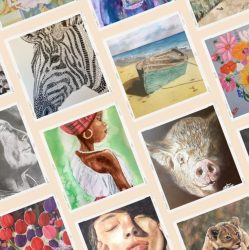
We’ve all done it… seen a painting or a photograph we like, whether in a book, magazine or newspaper, on the internet or elsewhere and feel the urge to paint it. Be assured there is nothing wrong or illegal whatsoever in copying a painting, a photograph of one or any other photo, a picture on a card or calendar, or any other image or artwork for the purposes of learning, teaching, reference, practice, caricature, parody or pastiche, research, criticism, review, discussion or private hobby. You do not need the original artist’s permission to use their work for these purposes, which are classed as “exceptions” within the UK Copyright, Design and Patents Act 1988. If used for any other purpose you should obtain the copyright holder’s permission, invariably that of the artist who painted the original.
Should you decide you want to put your copied painting on public display or exhibition, on the internet, enter competitions, offer it for sale, or use for any other commercial purpose permission from the artist is required. With over 377 pages of rules, the Act is complex and subject to changes, it is easy to understand the confusion and misconceptions that arise. Note too that copyright rules can vary between different countries.Below is a list of some of the sites on the internet that do offer free to use images. In all cases, do ensure you read and understand their terms of use.
Below are general guidelines we ask all members to be aware of and requested to observe.
- If copying artwork from any source for any purpose other than the “exceptions” above, seek permission from the copyright holder. Most are happy to say yes as long as they are given due credit on associated labels etc. Even where not specifically requested, it is best practice to include an acknowledgement of the artist.
- Where the artist cannot be located or contacted or does not respond, it is safest not to use their work. Simply adding a credit or acknowledgement does not validate its use.
- With paintings created during a workshop or paint-along, clarify with the tutor their position regarding how you may use the artwork you have created from their painting.
- If submitting artwork into public exhibitions, or competitions including online, it is important to read the Conditions of Entry or Submission Rules each time as these can vary, particularly pertaining to paintings copied from other artists or use of reference photos.
- Be aware that just because photos are on the internet or a website does not mean they are in the public domain and thus free to use for any purpose. Copyright laws still apply to these images.
- Many photograph repository sites on the internet including Shutterstock and Getty Images have a section marked “Free Images”, “Royalty Free” or “License Free”. These terms do not mean there is no copyright involved. These simply mean the images can be used under certain terms and conditions, and these should always be read and adhered to. Invariably a subscription or cost to use is involved.
- Images, whether in art books, magazines, newspapers, on cards or calendars or other printed matter are subject to copyright, whether held by the artist, the photographer, photo repository or publisher. It is therefore advised you read and follow their copyright rules.
- There is no statutory or copyright law which defines “fair use” or “substantial part” – it is always a matter of degree, impression or fact in each individual case. Some courts have interpreted this to mean a qualitatively significant part of a work even where this is not a large part of the work. Therefore, it is quite likely that even a small portion of the whole work will still be a substantial part or classed as a derivative copy of the original.
- A painting from a photograph can be deemed a derivative copy. Altering a small part, whether by omitting something, or adding additional items or figures, or changing the colours does not change the copyright status of the original photograph or artwork. It is better to use elements from different photographs to design your own work, or use photos you have taken yourself.
- Where artwork is deemed to be in the public domain, ie created earlier than 1920, in most circumstances it will be out of copyright and can be freely used, although credit should still be given on any label, eg “in the style of” or “from a painting by…” or similar.
- Images of familiar landscapes, streetscapes, buildings and monuments (eg Clifton Suspension Bridge, Stonehenge, Castle Combe, the Sycamore Gap Tree) are in general easier to use because these could be classed as being in the public domain, having been photographed by hundreds if not thousands of people, thus any a photographer or artist could find it difficult to prove an infringement has occurred.
 FROME VALLEY ART GROUP
You must be logged in to post a comment.