Watercolour Landscape
Having to previously cancel Barry’s scheduled visit in October, we were finally able to welcome artist Barry Herniman to present a demonstration in watercolours, the first of our 2024/2025 year. This demo wasn’t without a further hitch due to a cable breakage on the projector equipment, which meant the audience were unable to watch proceedings on the large screen. Barry paints sitting down with his easel slightly tilted, meaning it was difficult for many in the audience to follow his brushstrokes and actions. To overcome this, at intervals during the session, he walked around the audience to show where he was in the process. Following our refreshment break, committee members rearranged the seating so we were gathered closer around Barry to watch how he expertly completed his watercolour scene of a woodland bridge. Even so, it was difficult to follow his precise order of painting despite his excellent commentary, but I trust I have caught the main points.
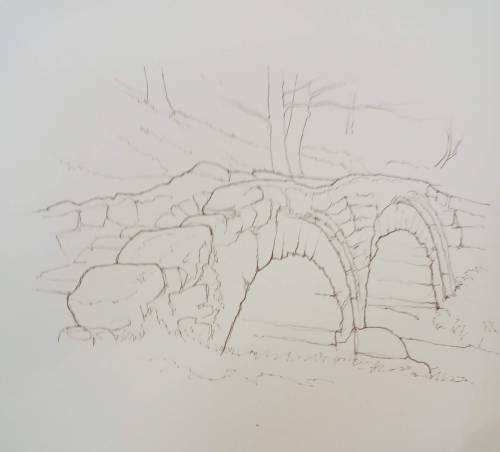
Barry arrived with a pre-drawn sketch on Hahnemühle Leonardo 300lb (600gsm) paper, which he does not wet before painting in order to achieve the hard edges he within the painting.
Using the “clover leaf” palette he’s designed (click here for info ) set out his Schmincke brand paints: Indian Yellow, Cobalt Blue and Cobalt Blue, Orange, and Manganese Violet. Barry does not use earth colours nor browns or greens, preferring to mix his own.
Beginning with a loose undercoat of basic colours (yellows) with a pointed round brush he dabbed in the background trees, and using yellow and a mixed green, flicked on the paint to create the moss on the bridge. With the end of the brush he also created foliage, painting up to the edge of the bridge, following his reference photo, keeping the light areas of bridge white, and working from light to dark. Reminding us this was all still the underpainting and that one doesn’t have to fill in the whole surface to create a picture, often a vignette can be a far more pleasing image, which was what he was painting today, he painted in the dark areas around the bridge, occasionally using the brush ferrule to create virtual lines with manganese violet and orange plus cobalt blue, concentrating on the main focus of the painting – the bridge.
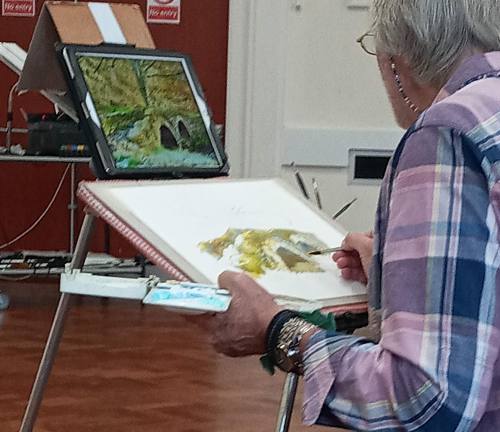
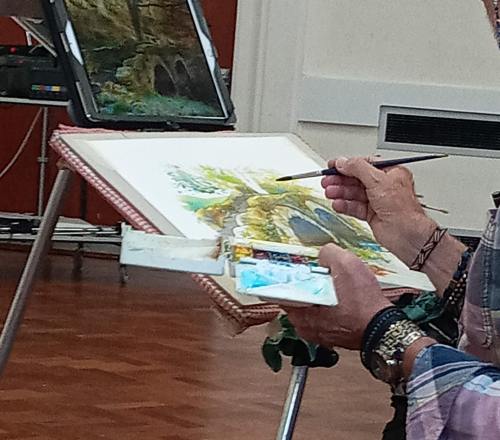
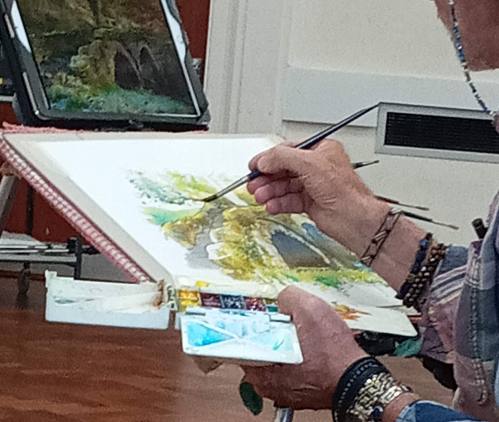
Whilst this area was drying, he flicked on more paint to the foreground grass with two shades of yellow without over-mixing in the palette and again, using the brush handle end, scratched the paint in a downward motion, allowing the paint to mix on the paper, and blending with his finger. Painting with very little water, without over-mixing, he emphasised the dark edges around the bridge, the darker areas under the bridge, and the steps on the bridge with blue/grey. Using yellow with a little blue, the background washes behind the bridge were added, ensuring to keep light areas light, always thinking light against dark. Orange was flicked on next to emulate the leaves and colour of the background trees, again working in a loose manner. Some spots stay put, others merged, which all create texture. Teasing and dabbing in further colours laying in the foreground area in the direction of the lay of the land.
Shadows were added using cobalt blue, and a dark brown for the trees, again mixing on the paper not in the palette.
Once this underpainting was completely dry, he proceeded with the next layers. Changing to a rigger, he emphasised the shadows and dark areas, and branches by pulling the rigger, not pushing it, and allowing the watercolour to work itself and do its own thing, reminding us paintings do not have to be perfect copies of reference photos, and to make sure not to overdo thinks such as darks and shadows but the little tweaks here and there can enhance the work.
More flicks of dark paint were put on the trees. Then, turning the paper upside down, and switching to a larger brush, he further darkened the areas under the bridge. Using turquioise he painted in the water under the bridge. The palette was cleaned so he could mix a “zingy” green using yellow and cobalt blue, tinkering a little here and there to bring the scene to life. Finally, using a rigger and using gouache white with a tiny bit of yellow he added small areas of around the base of the bridge to indicate water movement.
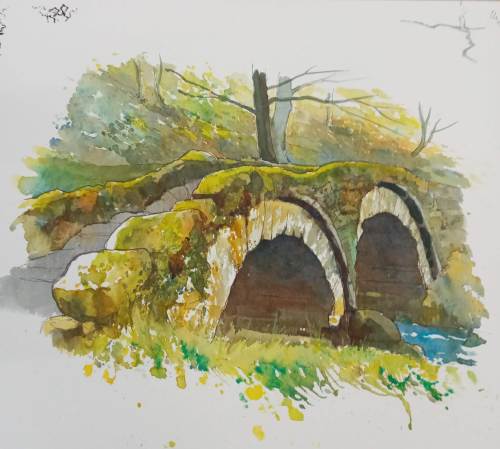
The painting was completed in a little under an hour and half. All in all, an excellent and enjoyable demonstration despite the difficulties. Barry proved an excellent tutor with a great sense of humour and fun. We hope he will be able to return in the future for another demonstration.
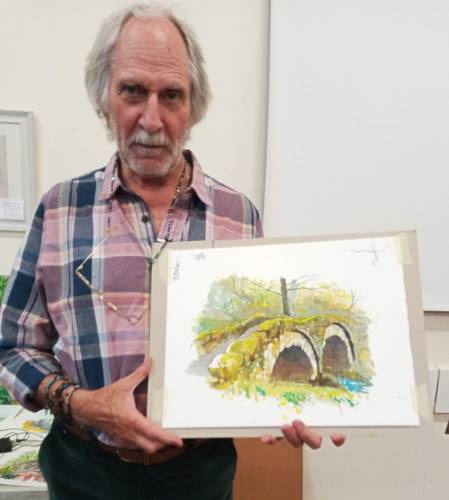
For Info: The demo was recorded at Barry’s request, and if we are able we will endeavour to add the video here and/or circulate to members. Barry paints in a different manner to many other watercolourists, almost an acrylic method, a style worth attempting if you find watercolour painting difficult. You may be surprised what you can achieve.
Barry’s website: https://barryherniman.com/
 FROME VALLEY ART GROUP
You must be logged in to post a comment.